Ask most trades owners how their ads are going and you'll get a number of leads.
Ask them which ad made them money and it goes quiet.
That's not a dig. For a long time we couldn't answer it properly either. We could tell you how many leads came in. We couldn't tell you which ad, or which version of an ad, turned into a sold job.
So the ad that made the phone ring the most looked like the winner. Turns out it wasn't.
Here's the problem with that. A lead isn't money. A lead is a cost. It only becomes money when a rep quotes it, the customer signs, and the job goes out the door at a decent margin.
If you can't see that whole line, you're judging your marketing on the first step and ignoring the rest.
It cuts the other way too. A channel that only sends a handful of leads might be the one quietly sending your best jobs. If you only count leads, that's the one you cut first.
Given the above, this is what we built into pikle.
Every lead lands in one pipeline with its source and what it cost. If it came from an ad, the tracking from the click comes with it, so it's tied back to the campaign that paid for it. If it came from a referral partner, a website form or a paid lead service, that's recorded on the lead too.
Then the lead gets assigned to a rep. They quote it. It sells or it doesn't, and if it doesn't, the reason gets captured. Every step sits on the same record, so nobody has to rebuild the story later.
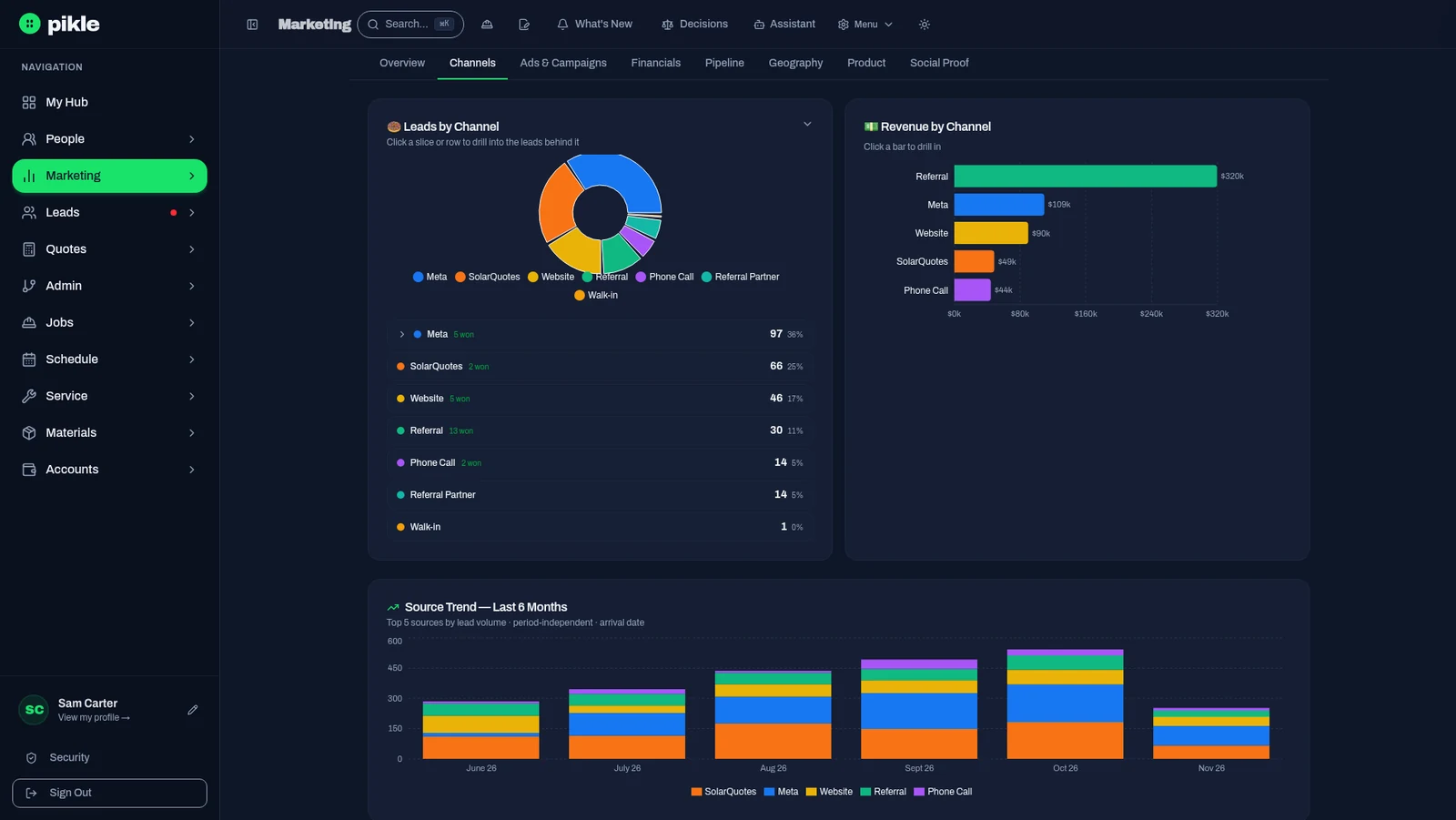
That means the marketing report doesn't stop at leads. It runs leads to quotes to wins to sold revenue, by source and by channel. You can see which ads made you money, not just which ones made you leads.
Every lead source goes in the same way, whether that's an ad, a paid lead service, a referral partner or the sign on the ute. You enter what it cost, once, manually or on a schedule, and it lands in the same report. Every lead carries its source, so you can line them all up side by side.
It goes one step further than most marketing reports. Because the lead carries through to the rep, each rep's quote volume, conversion and sold revenue sit right alongside the source numbers. Sometimes the ad isn't the problem. Sometimes a good lead just landed with the wrong person on the wrong day. You can't fix that if you can't see it.
Here's what it showed us. We now track every ad, down to the variant, and every channel through to the individual sale. So we know which ads give us the best return on ad spend. It was eye-opening. The ads bringing in the most leads weren't the ones with the best return. Some of our more expensive leads turned out to be the better ones, because of what the jobs we delivered to them returned.
It also means we can work out our true cost to win a customer across all our leads combined, not just channel by channel. That number now drives real decisions, like how much we put into referral incentives.
None of this needs a marketing degree. It needs the lead, the quote and the sold job on the same record. Once they are, the report builds itself.
The point isn't to spend less on marketing. All things being equal, I'd rather spend more on the stuff that works. The point is knowing which stuff that is.
You don't want to be the business still pouring money into the campaign that keeps the phone ringing, without knowing it's the one that never sells.
Count the money, not the leads.
We're now signing 20 founding businesses. The first 20 businesses get 50% off for 12 months, then price locked for 24 months. We move your data across for you. Join the Founding 20 waitlist, or book a demo and we'll show you your own marketing numbers in pikle.