Friday, 3pm. The week's jobs are done. The crews are heading home. And someone in the office is on the phone working down a list.
Did you do the safety form for that job? Where are the commissioning sheets? Can you send the photos of the switchboard? Which job was that again?
If you run a trades business, you know this call. You've probably made it.
The work got done. That's not the issue. The issue is the paperwork that proves it got done, done properly and done safely. That lives in someone's glovebox, someone's camera roll, or someone's head.
And it matters more than most people outside the trade realise. Commissioning sheets aren't admin for the sake of admin. Safety paperwork isn't optional. Site photos are what you lean on when a customer rings 18 months later, or when a claim needs backing up. If it's missing, you're exposed.
So it gets chased. Every week. By people who should be doing something more useful.
We lived this as we grew to a 50+ tradesperson business. More crews, more jobs, more paperwork, and the same Friday ring-around getting longer every month. What you walk past is the standard you accept, and we were walking past it because there was no easy way to see it.
So when we built pikle, the paperwork went on the job, not beside it.
pikle has a proper Field App, built for crews on site, not a website squeezed onto a phone. The crew opens their job in it and clocks on. The safety documents for that job are right there, filled in and signed off on site. Commissioning sheets and completion forms come from templates, so everyone fills in the same thing the same way. Site photos are taken straight into the job, sorted by category, so the switchboard photo isn't buried between 40 shots of the roof.
When the crew does it, the office sees it. Straight away.
The same goes for your subbies. There's a contractors version of the app, so subcontractors get their jobs and work orders and do their paperwork in pikle too, on the same job record as your own crew.
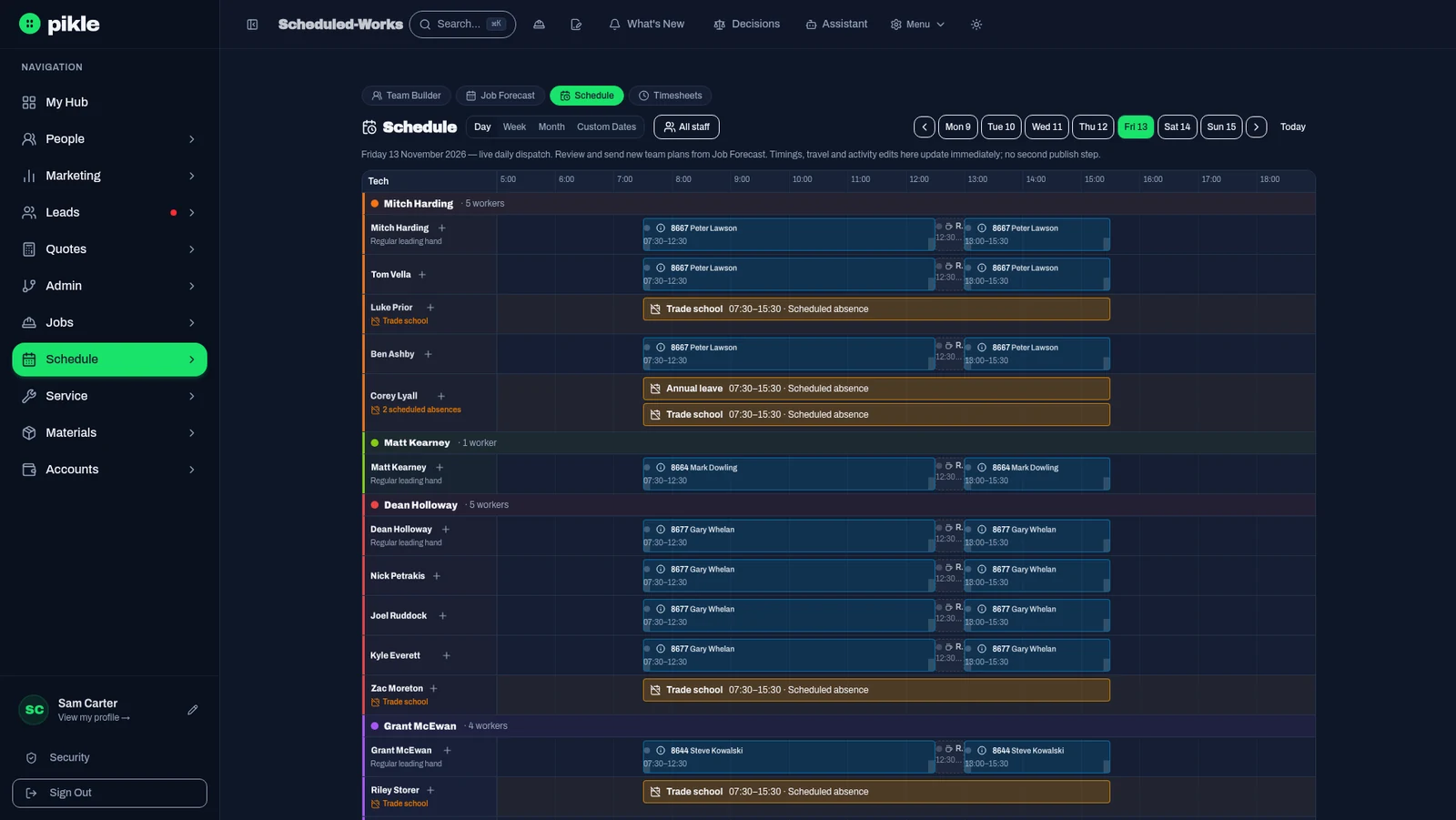
That's the bit that changes the Friday. Instead of ringing around, you look at a screen. Completion is tracked per job and per team, so you can see at a glance which jobs are complete and which aren't. If something's missing, you know which job, which form and which crew. One call, not twenty. The office stops being the paperwork police, and the Friday ring-around stops being a ritual.
It also sits alongside margin. In pikle, the install team scorecard shows what each crew made on the jobs they ran, next to whether their checklist was done. That keeps the two honest. A crew that's quick but leaves the paperwork behind isn't really quick. A crew that does both is the standard you want everyone to see.
The same thinking runs through the rest of the compliance side. Licences carry expiry dates, and pikle flags them before they lapse. Vans and plant carry service dates too. It's the boring stuff, and it's exactly the boring stuff that bites you when it's missed.
We used to run our forms and safety documents across 3 separate apps. All 3 are gone now. Across the business, pikle gives me back about 20 hours a week of my own time, and what it saves the office and the crews is a lot more than that.
None of this is about watching the crew. Good tradies want to get it right. They just want a way of doing it that doesn't mean typing it up at home on a Sunday. Give them one spot to do it on site and they'll do it.
Paperwork done on site is paperwork you never have to chase.
You don't want to be the business finding out a commissioning sheet is missing when the customer, the regulator or the insurer asks for it. Do it right the first time.
We're now signing 20 founding businesses. The first 20 businesses get 50% off for 12 months, then price locked for 24 months. We move your data across for you. Join the Founding 20 waitlist, or book a demo and bring a recent job. We'll walk it from lead to invoice, paperwork included.