Here's the question we open every pikle demo with. How long would it take you, right now, to tell me what your best job this month made?
Not what it was quoted at. What it actually made, after labour, materials, the extra visit and the variation nobody priced.
Most people can't answer it quickly. That's not because they're bad at business. It's because the number usually doesn't exist until the job's finished, invoiced and reconciled. Sometimes not until the accountant gets to it.
By then it's history. You can learn from it, but you can't fix it.
That's the problem with finding out after the invoice. The job's done. The crew's moved on. If the margin leaked, it leaked weeks ago, and there's nothing left to do but hope the next one goes better.
I learnt this the hard way, pulling job margins together by hand at 2am for a bonus scorecard. The information was all there. It just arrived too late to be useful.
So in pikle, the margin starts at the quote and stays live the whole way through.
It starts with pricing. Quotes are built off your own catalogue, your own rates and your own margin targets. You can set a minimum margin floor, so a quote below it needs a manager to approve it before it goes out. Your internal cost splits stay hidden from reps, so they sell on the price, not on the cost.
It works the same for small jobs as big ones. A string of small jobs each leaking a little adds up quicker than one big job going wrong, and the small ones are the jobs nobody has time to check by hand. Your reps see the price. You see the margin.
That means before a job is even booked, you know what it should make.
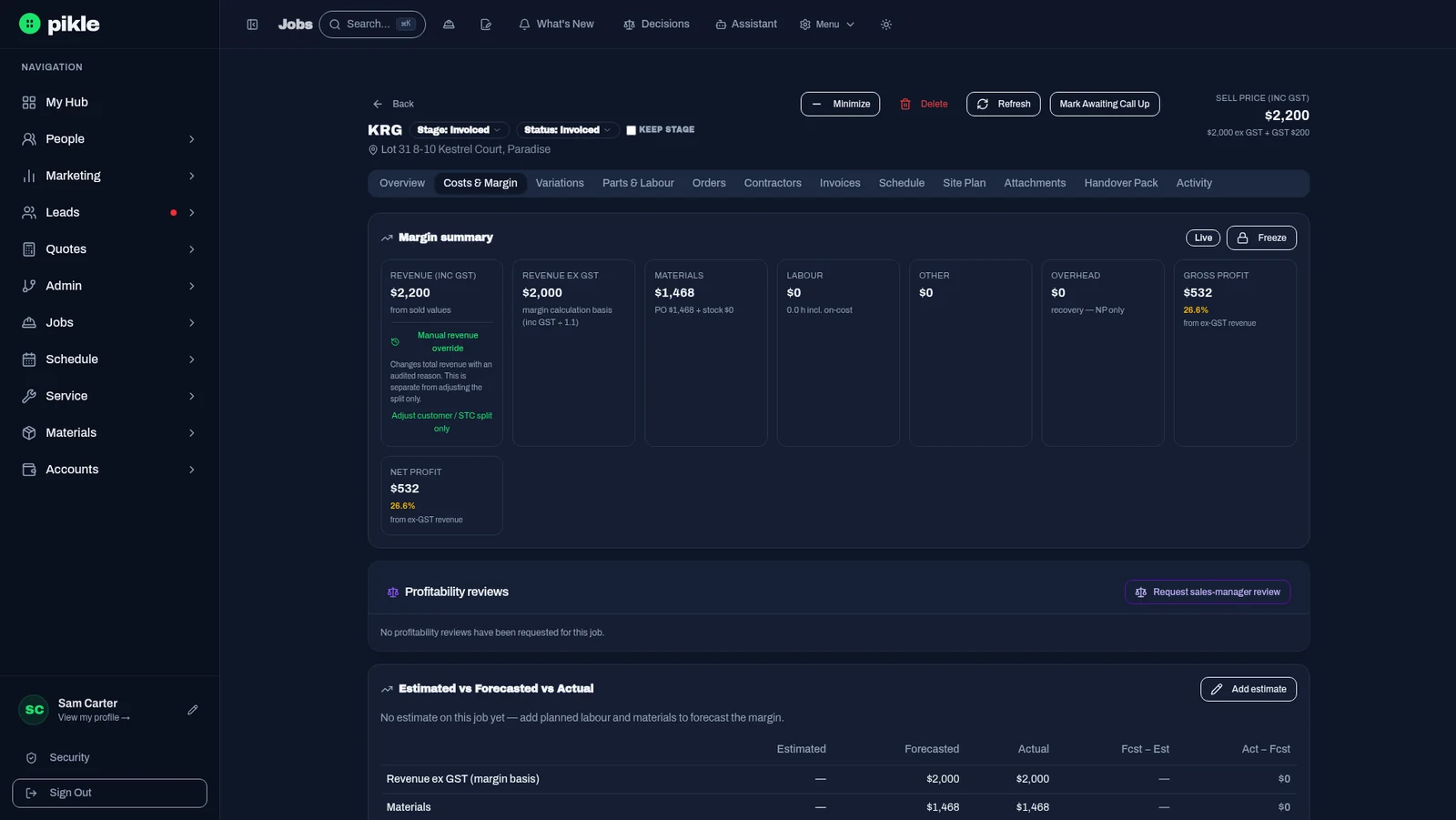
Then the job goes live. The quote becomes the job estimate. Purchase orders are raised against the job, so materials land on the right job cost. Crews clock on and off in the Field App, and their time is costed against the job automatically at the right rate. Van stock, contractor costs and other costs all land on the same record.
So at any point, you can open a job and see estimate against actual. Revenue, materials, labour, other costs, gross profit, all on one screen while the work is still happening.
That's where it gets useful. If a job is drifting, you see it while there's still time to do something. Maybe it's an extra visit that should be a variation. Maybe the materials came in higher than quoted. Maybe the crew needs a hand. Whatever it is, you're making the call on Wednesday, not reading about it next month.
Every other system tells you what happened. pikle tells you what's about to. Because the quote, the costs and the schedule all live together, you can see where a job, a month and a year are heading, not just where they've been.
And when the job's done, the numbers are frozen as a snapshot. Your margins report shows completed jobs as they finished and open jobs live. The invoice goes out from the same job and syncs to Xero, so nobody re-keys it.
Here's a real one from our own business. pikle's forecasting picked up a job sitting at 5% margin before it was installed. In the old days that job goes in, and we find out after the fact. This time we caught it early, had the conversation with the client and upsold the job to win some of that margin back. That's the difference between reading about a problem and fixing it.
That's one job. Across the business, we've improved our margin by 7% since implementing pikle.
We don't back-cost jobs any more. Nobody's hunting down missing numbers at the end of the month. The number is just there.
None of this replaces a good estimator or a sharp ops manager. It gives them the numbers early enough to use them.
A number that arrives after the invoice is a history lesson. A number that arrives during the job is a decision.
You don't want to be the business that's flat out all year and still can't say which jobs paid for the others. Poor man pays twice.
We're now signing 20 founding businesses. The first 20 businesses get 50% off for 12 months, then price locked for 24 months. We move your data across for you. Join the Founding 20 waitlist, or book a demo and bring a recent job. We'll show you what it made.