When there were 4 of us, the system was me.
I knew every job. I knew which customer was waiting on what, which crew was where and roughly what each job was going to make. If you wanted an answer, you asked me, and I usually had it.
Then we grew. From 4 staff to a 50+ tradesperson business in under 2 years. And every system we had broke on the way.
Not all at once. One at a time, in roughly this order.
Quoting went first. As we added reps, quoting ended up spread across 3 tools and a spreadsheet. Nobody could tell you, without digging, what had been quoted to whom and what it was going to make.
Then finding things broke. A job number, an install date, an update on where a job was up to. Simple questions that used to take 10 seconds started taking hours, because the answer lived in someone's inbox, someone's spreadsheet or someone's head.
Then the handover between sales and the field broke. If I'm honest, it was always a weak spot.
A job would sell, and that's when the double handling started. Getting it to the point where it could be scheduled meant keying the same details in again, then again somewhere else. Things got entered twice. Nobody was quite sure which version was the right one.
The photos and notes were worse. A photo from the quote would end up sitting in a text thread. A note about the site would live in a rep's head or a notebook. By the time it had been passed along a few times, half the detail was gone or garbled. The crew would rock up without what they needed, and the office would be on the phone chasing it all over again.
Then paperwork broke. More crews meant more safety forms, more commissioning sheets and more photos, all landing in different places. Friday afternoons became a ring-around.
And last, the numbers broke. The ones that tell you whether the business is actually working. Job margins, rep performance, crew performance. I ended up spending three nights in a row until 2am pulling them together by hand for a bonus scorecard. That was the low point.
Here's what I worked out afterwards. None of those breaks were really separate problems. They were the same problem showing up in different places. Every part of the business had its own system, and none of them talked to each other.
At 4 people, that's fine. You are the glue. At 50+, you can't be. There aren't enough hours, and you'll burn out trying. I did.
The warning signs are easy to spot once you know them. Questions that used to take seconds start taking hours. The same information gets typed in twice. And you become the only person who can answer how the business is going. That last one is the dangerous one.
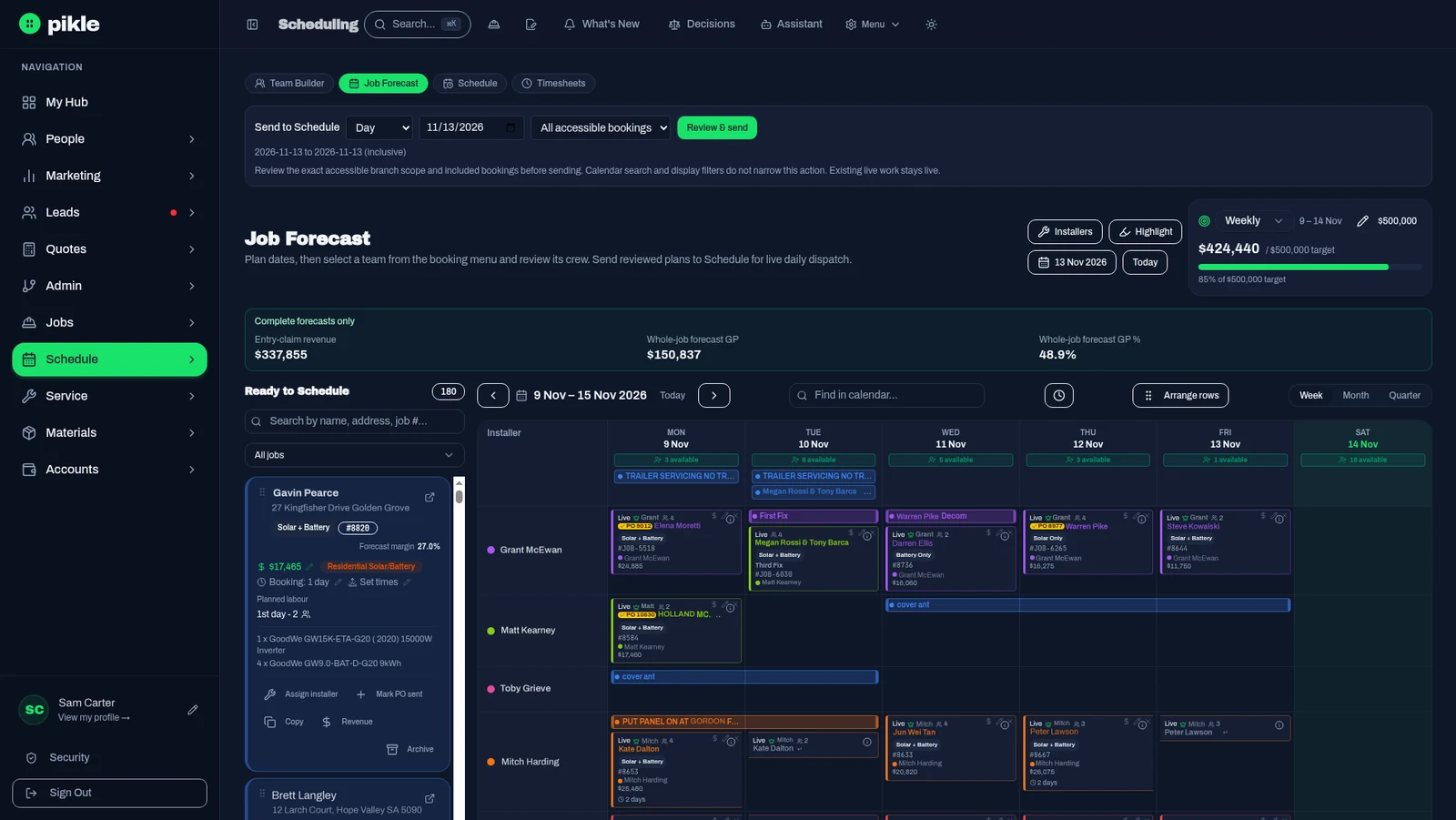
When I went looking for help connecting the systems we had, I got told it couldn't be done or quoted a fortune to do it. So we built one system where it all connects. That's pikle.
One record runs from the lead to the invoice. Quotes come off the same pricing for every rep. Handover is one click, and the job comes through properly quoted with every detail the crew needs. Paperwork is done on the job, on site. Costs land as they happen. And the numbers I used to build at 2am sit there live.
Here's the honest version of what it's done for us. We couldn't have handled any more revenue without pikle. It cut the chaos, and it meant we didn't have to add overhead we didn't need.
If you're growing now, here's what I'd tell you. If this were my business again, I'd sort the system before the next 10 hires, not after. Every person you add on a broken system makes the mess bigger and the fix harder.
I'm not saying stop growing. I'm saying grow on something that won't break when you do.
You don't want to be the owner who doubled the team and tripled the admin. We've been there. It's not a fun place to be.
Do it right the first time.
We're now signing 20 founding businesses. The first 20 businesses get 50% off for 12 months, then price locked for 24 months. We move your data across for you, and you get a say in what we build next. Join the Founding 20 waitlist, or book a demo and we'll show you how it would look in your business.